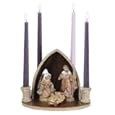
Showing posts with label Liturgical Seasons of the Year-Advent. Show all posts

Saturday, December 2, 2017

Advent Year B Happy New Year

 
Happy New Year.
 
 
Welcome to Advent- the start of the liturgical Year- Year B in the liturgical cycle.
What is your new Year resolution?  I mean your spiritual resolution for this new Year.
As I look back over the last liturgical year,  I am glad that Jesus is patient because I know I have not grown as much spiritually as I could. Plenty of room for improvement.!!! Hopefully you had a wonderful spiritual year and can built on it this year.
 
Sometimes we can be so overwhelmed as we undertake a stocktake of our lives that we give up hope.
If you are feeling a little like this after a stocktake, why not receive the sacrament of reconciliation- Jesus is waiting to welcome us and to lift the burden from our hearts. It is also a wonderful time to receive this sacrament leading up to Christmas.
 
What I like to do on the first Sunday of Advent is to set my spiritual goals for the Year with the view of growing spiritually throughout the year.  What about you?   Here is a list of some of my goals for the Year.
 
1. Receive the Sacrament of Reconciliation regularly: I know I can put off attending this sacrament throughout the year- so when I get my new diary, I write in regular dates for this sacrament. I think of it as a date with Jesus. Generally the very act of writing the dates in for the whole year helps me to not leave this sacrament to chance.  It says to me it is important.  It also means I can lock out this time for the sacrament. When things come up during the year, I can easily say no or work around it ensuring that this sacrament does not become neglected in my life.
Receiving the sacrament in Advent gets me off to good new year.!!!
 
2. Attending Mass during the week: I like to attend Mass during the week either daily or as often as I can. I know when I hear myself say '' I cant be bothered'' or it is too hot, too cold etc that my soul is backsliding. However when I attend Mass daily, there is also a danger that I attend because I promised myself I would as if I can tick that goal off the list.  Being mindful of why I am attending Mass is vital and keeping God as no 1 in my life critical to my spiritual growth.
 
3. Exploring different ways of praying: I like to attend Evening Prayer with the Friars. Living on my own can be great for my personal prayer but communal prayer can be missing when I do not make an effort to attend.   Thankfully in my parish,  we have communal evening prayer. 
However I can become ''bored'' with the routine.  Exploring and understanding more about the psalms is something I want to learn about this year.
 
4. Helping Others: At the last judgement, we will be judged on how we have helped others.  We may not be able to help others who are in great need on the other side of the world with our presence. We can definitely pray for them,  or give financially if we are able.
However we may be able to help someone in need closer to home- in our own home or neighbourhood or parish. We may be able to highlight a cause or run and event ( a morning tea/afternoon tea/ trivia night )  for it with the proceeds going to the cause. 
Perhaps we can seek out someone in the parish who needs assistance in some way and give it to them or perhaps we can join a group in the parish or even start a group that fills a need.   This latter idea is what I want to do- I want to start a group that fills a need in the parish- don't know what yet ( keep you posted).
 
5. Identifying one vice in my life and changing it into a virtue. I have identified a habitual sin and I have committed myself to eradicating it this coming year. Working on one area is better than not working on any. It gives impetus as well and focus for the year.
 
These 5 ideas will definitely keep me going for the year- I may add others as the year unfolds.  However, as this new liturgical Year starts, I wish to commit myself to knowing and loving God more in my life and showing it in my life.  
 
                                What will be YOUR commitment to God this New Year?


Thursday, December 15, 2016

The O Antiphons

O ANTIPHONS OF ADVENT.


ADVENT WREATH- SYMBOL OF ADVENT.

An Antiphon is a song, prayer or psalm chanted in responsorial fashion. 

The O Antiphons, also known as ‘’The great Os’’ are Magnificat antiphons used at Vespers of the last seven days of Advent in Western Christian traditions. They are also used as the alleluia verses on the same days in the Catholic Mass.  The Roman Church has been singing the "O" Antiphons since at least the eighth century. They are the antiphons that accompany the Magnificat canticle of Evening Prayer from December 17-23. They are a magnificent theology that uses ancient biblical imagery drawn from the messianic hopes of the Old Testament to proclaim the coming Christ as the fulfillment not only of Old Testament hopes, but present ones as well. Their repeated use of the imperative "Come!" embodies the longing of all for the Divine Messiah.

The O Antiphons refer to the seven antiphons that are recited (or chanted) preceding the Magnificat during Vespers of the Liturgy of the Hours. They cover the special period of Advent preparation known as the Octave before Christmas, Dec. 17-23, with Dec. 24 being Christmas Eve and Vespers for that evening being for the Christmas Vigil.

Hear how the seven O Antiphons of Advent summarize the hopes of the people in the old Testament who waiting for the coming of the Messiah:
  • O Come O Wisdom
  • O Come O Lord of Might
  • O Come O Rod of Jesse's Stem
  • O Come O Key of David,
  • O Come O Dayspring,
  • O Come Desire of Nations,
  • O Come O Emmanuel ( God with us).
" O Come O Wisdom..." comes from Book of Sirach chapter 24, which speaks of Wisdom as coming from God and foreshadowing the Divine Word : Jesus.

" O Come O Lord of Might..."'  The Messiah would be the powerful Lord.  In previous times this powerful Lord was hidden but now his power and his person will be seen clearly.

''O Come O Rod of Jesse's Stem..."This refers to Jesus' relationship to David.  Joseph, Jesus' earthly father, was a descendent of the line of David.

'' O come O Key of David..." David and his descendants Joseph and Jesus would hold the key that would unlock heaven.

''O come O Dayspring...'' The Messiah will be like the dawn bringing the hope of a new day.  even death will not stand in his way.

'' O come O Desire of Nations..."' The Messiah will not be Saviour just for the house of Israel, but all nations will be ruled by this prince of Peace.

'' O come O Emmanuel." Emmanuel means 'God-with-us "and is a term that applied to Jesus in the gospel (Mt 1:23).

ORIGIN OF O ANTIPHONS.
The exact origin of the ‘’O Antiphons’’ is not known. Boethius (c. 480-524) made a slight reference to them, thereby suggesting their presence at that time. At the Benedictine abbey of Fleury (now Saint-Benoit-sur-Loire), these antiphons were recited by the abbot and other abbey leaders in descending rank, and then a gift was given to each member of the community. By the eighth century, they are in use in the liturgical celebrations in Rome. The usage of the O Antiphons was so prevalent in monasteries that the phrases, Keep your O and The Great O Antiphons were common parlance. One may thereby conclude that in some fashion the O Antiphons have been part of our liturgical tradition since the very early Church.

IMPORTANCE OF THE O ANTIPHONS.
The importance of O Antiphons is twofold: Each one highlights a title for the Messiah: O Sapientia (O Wisdom), O Adonai (O Lord), O Radix Jesse (O Root of Jesse), O Clavis David (O Key of David), O Oriens (O Rising Sun), O Rex Gentium (O King of the Nations), and O Emmanuel. Also, each one refers to the prophecy of Isaiah of the coming of the Messiah. Let’s now look at each antiphon with just a sample of Isaiah’s related prophecies :

O Sapientia: O Wisdom, O holy Word of God, you govern all creation with your strong yet tender care. Come and show your people the way to salvation. Isaiah had prophesied, the spirit of the Lord shall rest upon him: a spirit of wisdom and of understanding, a spirit of counsel and of strength, a spirit of knowledge and fear of the Lord, and his delight shall be the fear of the Lord. (Isaiah 11:2-3), and Wonderful is His counsel and great is His wisdom. (Isaiah 28:29).

O Adonai: O sacred Lord of ancient Israel, who showed yourself to Moses in the burning bush, who gave him the holy law on Sinai mountain: come, stretch out your mighty hand to set us free. Isaiah had prophesied, But He shall judge the poor with justice, and decide aright for the lands afflicted. He shall strike the ruthless with the rod of his mouth, and with the breath of his lips he shall slay the wicked. Justice shall be the band around his waist, and faithfulness a belt upon his hips. (Isaiah 11:4-5); and Indeed the Lord will be there with us, majestic; yes the Lord our judge, the Lord our lawgiver, the Lord our king, he it is who will save us. (Isaiah 33:22).

O Radix Jesse: O Flower of Jesse's stem, you have been raised up as a sign for all peoples; kings stand silent in your presence; the nations bow down in worship before you. Come, let nothing keep you from coming to our aid. Isaiah had prophesied, But a shoot shall sprout from the stump of Jesse, and from his roots a bud shall blossom. (Isaiah 11:1), and A On that day, the root of Jesse, set up as a signal for the nations, the Gentiles shall seek out, for his dwelling shall be glorious. (Isaiah 11:10). Remember also that Jesse was the father of King David, and Micah had prophesied that the Messiah would be of the house and lineage of David and be born in David’s city, Bethlehem (Micah 5:1).

O Clavis David: O Key of David, O royal Power of Israel controlling at your will the gate of Heaven: Come, break down the prison walls of death for those who dwell in darkness and the shadow of death; and lead your captive people into freedom. Isaiah had prophesied, AI will place the Key of the House of David on His shoulder; when he opens, no one will shut, when he shuts, no one will open. (Isaiah 22:22), and His dominion is vast and forever peaceful, from David’s throne, and over His kingdom, which he confirms and sustains by judgment and justice, both now and forever. (Isaiah 9:6).

O Oriens: O Radiant Dawn, splendor of eternal light, sun of justice: come, shine on those who dwell in darkness and the shadow of death. Isaiah had prophesied, The people who walked in darkness have seen a great light; upon those who dwelt in the land of gloom a light has shown. (Isaiah 9:1).

O Rex Gentium: O King of all the nations, the only joy of every human heart; O Keystone of the mighty arch of man, come and save the creature you fashioned from the dust. Isaiah had prophesied, For a child is born to us, a son is given us; upon his shoulder dominion rests. They name him Wonder-Counsellor, God-Hero, Father-Forever, Prince of Peace. (Isaiah 9:5), and He shall judge between the nations, and impose terms on many peoples. They shall beat their swords into ploughshares and their spears into pruning hooks; one nation shall not raise the sword against another, nor shall they train for war again. (Isaiah 2:4) .

O Emmanuel: O Emmanuel, king and lawgiver, desire of the nations, Saviour of all people, come and set us free, Lord our God. Isaiah had prophesied, The Lord himself will give you this sign: the Virgin shall be with child, and bear a son, and shall name him Emmanuel. (Isaiah 7:14). Remember Emmanuel means God is with us.

According to Professor Robert Greenberg of the San Francisco Conservatory of Music, the Benedictine monks arranged these antiphons with a definite purpose. If one starts with the last title and takes the first letter of each one - Emmanuel, Rex, Oriens, Clavis, Radix, Adonai, Sapientia - the Latin words ero cras are formed, meaning, Tomorrow, I will come. Therefore, the Lord Jesus, whose coming we have prepared for in Advent and whom we have addressed in these seven Messianic titles, now speaks to us, Tomorrow, I will come.


So, the O Antiphons not only bring intensity to our Advent preparation, but bring it to a joyful conclusion.

Sunday, December 4, 2016

Understanding Advent Liturgical Readings


UNDERSTANDING ADVENT LITURGICAL READINGS.

ADVENT WREATH= SYMBOL OF ADVENT.


Do you feel you would like to read the Scripture for the day but don't quite understand the structure and then feel you are moving all over the place without an anchor?

The Scripture in Advent are carefully planned both for Sundays and Weekdays.

The Sunday themes move from Second Coming of Christ on the first Sunday of Advent, to John the Baptist preparing for the coming of Jesus on the Second and Third Sundays. On the fourth Sunday, the Gospel of Matthew or Luke announces the conception of Jesus and Mary's visit to her cousin Elizabeth, (John the Baptist's mother).

DAYS 1-9 OF ADVENT


During the first 9 days of Advent during the week, the first reading for the Eucharistic liturgy comes from the book of the prophet Isaiah.  These readings express the compassion of God for His people and the longing of the people for messianic age. Do we have that same longing?

DAY 10 ONWARD.


After the Thursday of the second week of Advent, the gospel readings speak of John the Baptist whilst the first readings are either from Isaiah or a reading compatible with the gospel. 


From December 17-24, the readings are taken from Matthew and Luke.  These present the events that led up to the birth of Jesus. Enter into these as deeply as you can to help you keep your spiritual focus in preparation as you prepare the presents, decorations, parties and food.

OUR HOLY SEASON OF ADVENT


Let us be like our forebears and enter into the unbroken tradition of those who prayed and waited for the faithful God to bless his people with a Messiah.

Reading part of the Scripture of the day or all of it will help you journey through this holy season and help you prepare for the coming of Christ- the Word made flesh at Christmas.


Monday, November 28, 2016

Wake up and Stay alert

HAPPY NEW YEAR


ADVENT WREATH.


It is the start of the new liturgical year - Year A and it is time to enter into more deeply the season of Advent.  Advent recalls the waiting for the Messiah of course, but it is also about the second coming of Christ in all His glory at the end of time.

I especially like Advent because it gives me a chance to review my life and make a plan, set goals and have a very good stocktake of myself.   I especially love Year A of Advent because it gives me the opportunity to set a bigger picture plan over 3 years.  How many times when you go to an interview is the question asked ''Where do you want to be in 5 years’ time?  I like to ask myself that same question using the 3-year cycle instead.

It is always good to acknowledge growth because it can motivate us to know that good has occurred. Reviewing my life is good because it helps me to refocus my attention to what matters.  Setting goals and making an effort to implement them keeps me on track to further progress. Using these tools for my spiritual growth seems an obvious extension.

So, I ask myself
  1. What areas of my life do I want to be different this time next year, 2 /3 years’ time?
  2. what areas do I want to work on specifically in Advent?
  3. Do I need someone else to journey with me to encourage me on my journey- a spiritual director, a Christian counsellor, a spiritual mentor - if so, who might that be?
  4. what goals will I set and how will I implement them- in other words I set the goals and then break the goals down into manageable bite size pieces- putting a general time line on these goals is important b/c it keeps me motivated.  However there is always more with God and His timeline may be different from mine.  So I keep this point firmly in mind- not as an excuse to fail but as a realistic factor in the journey of faith.
Advent too is a penitential season. We are reminded of it with the violet vestments that the priest wears.  Leading up to Christmas can be difficult with various parties to include some fasting.  However, with intention to include it as part of your advent journey, it can be achieved. 

Start small- maybe you fancy another mince pie.  They are a real weakness of mine!!
Going without a second, third or fourth one is a starting point.  Remember though your motive.  Is your motive God related or weight related?  Do you have a tendency towards greed or lack of temperance in food/drink? If so, then start small and make a start to change this vice towards a grace/virtue.
This way you can enjoy celebrating with your family/friends but you can also celebrate your own spiritual growth.

Many of us do a good spring clean before Christmas before family and friends come.  What about a spiritual spring clean?  What will do about your soul this advent?

I encourage you to not let Advent pass you by spiritually.  It is a very quick season liturgically speaking but we are meant to be in an attitude of waiting- waiting expectantly.

I hope you wait expectantly and with hope during this season of Advent.

Happy New Year.


Sunday, November 29, 2015

Why have an advent wreath?


THE ADVENT WREATH?


Happy new Year!!!  We have just started Year C in the Liturgical cycle.  With a new spiritual new year gives us the opportunity to begin again and move forward spiritually with hope.

Since the 900s Advent has been considered the beginning of the Church year.  The word Advent is from the Latin adventus for "coming" and is associated with the four weeks of preparation for Christmas. Advent always contains four Sundays, beginning on the Sunday nearest the feast of St. Andrew the Apostle, (November 30) and continuing until December 24. It blends together a penitential spirit, very similar to Lent, a liturgical theme of preparation for the Second and Final Coming of the Lord, called the Parousia, and a joyful theme of getting ready for the Bethlehem event.   

The Advent Wreath represents the time before Christ when people waited for the coming of the Messiah, the Light of the world. Each year in Advent people wait once again 'in darkness 'for the coming of the Lord, His historical coming in the mystery of Bethlehem, His final coming at the end of time, and His special coming in every moment of grace.

"Customarily the Advent Wreath is constructed of a circle of evergreen branches into which are inserted four candles. According to tradition, three of the candles are violet and the fourth is rose.” (Book of Blessings 1510).  

 The Advent Wreath is an important liturgical symbol which helps us to prepare the way of the Lord with the lighting of the candles each week.  During Advent, family and friends can gather around the Advent Wreath lighting the appropriate candle(s), read from the daily Advent meditation and sing Advent hymns. The Church's official Book of Blessings also provides a blessing ceremony for the Advent Wreath which can be used in the absence of a priest.   

The rose candle is lit the third Sunday of Advent, for this colour anticipates and symbolises the Christmas joy announced in the first word of the Entrance Antiphon: "Rejoice" (Latin, Gaudete). For this reason, the Third Sunday is also called Gaudete Sunday, and rose colour vestments are permitted. The traditional colour of the vestments during Weeks 1, 2 and 4 is either purple or violet to represent penitential spirit. Advent is a season of hope, but a penitential spirit during this season is a fitting way to prepare the way of the Lord.  

USING THE ADVENT WREATH AT HOME

 Using the same Advent Wreath for each year at home can be effective, as it gives a sense of continuity. As each Advent passes, I prefer to create it differently, without losing my continual sense of journeying with the Lord.  However, a few years ago, I used a different Advent Wreath to coincide with the liturgical season of years A, B, or C.  This approach helped me differentiate between Years A, B and C and head the call to prepare the way of the Lord seriously- a fresh start to the liturgical year. Today we are blessed with so many different types and styles from which to choose, some of which can be seen here

When lighting the Advent Wreath, it should be lit as a circular journey with the fourth candle at the front of it- the nearest to Christmas. In more recent times, some people prefer to add a white candle to represent Christmas.  However, although this has some practical merit for our home Advent Wreaths, it is important liturgically not to confuse the liturgical symbols- the Advent wreath is specific and associated with Advent with its 3 purple and one rose colour candle, whilst the Crib with Christmas.  

As we start the new liturgical year, we may wish to spend some time reflecting on our past year. We may think of what has gone well spiritually and what needs fine tuning and what needs a major renovation. 

I recently bought some so called ''advent calendars'' (commercial variety of course).  However, it got me thinking.   Before embarking on setting up a programme that may lead to impossibility to achieve, I have decided to focus on advent, to open the window of my advent calendar each day, and decide on one or two areas in my life to be alert and stay awake to throughout that day and through this advent season. I have yet to decide on the chocolate- hopefully give it to someone who will appreciate it along with a prayer/act of kindness for him/her.  Hopefully then, 1 will then welcome Christ at Christmas more spiritually alert and awake. 

How will YOU stay awake this Advent?


Sunday, November 30, 2014

A New Liturgical Year- First Sunday of Advent Yr B

Happy New Year- a liturgical New year.

Advent Wreath: Symbol of Advent.


Happy New Year- a liturgical New Year-Advent the Season of Hope.


With a liturgical New year, there is hope in the season of Advent.  I look forward to Advent because with the start of Advent and a new liturgical Year, the Church provides us with the opportunity to start again. I can ask God to help me start again.  It really is a case of ’’Just give me another year Lord and I will dig and manure it...."

I can close the door on the past and start again.  The problems may not go away, but the difference is that I have Jesus by my side again- I have hope again and I can, through His grace continue the struggle of life with the hope that someday, things will be better.

Perhaps if you are in a good place emotionally and spiritually, then at least be grateful. Use this Advent well to be grateful, or at least to stop and think and decide to change something in your life that needs attention- be on the alert- is your life really in keeping with God's plan for you?  I hope it is, but if not, start to make the adjustments through this season of hope.

I want to create again a spiritual new Year goal.  I know I can’t change myself without God’s help and I can’t change it all in a day.  I have another year to use wisely. So, instead of wanting to change the world within myself, I will choose one aspect. just one and sincerely ask God to help me change that this year.  I sure dont want to be in the same place this time next year.

So Happy New Year- I hope you have a think about your spiritual goals and hope, with Jesus, that you will act on them.  We can act on them one day at a time, one hour or one minute at time, knowing that God loves us in our hope, loves us when things are going well and we are happy, and loves us when we fail too and come to Him.

Let us prepare for the coming of Jesus and allow Him to be born in our hearts again this Christmas.
Stay awake and be alert.  Happy New Year.

Saturday, December 14, 2013

Rejoice in the Lord Always- Gaudate Sunday


REJOICE IN THE LORD ALWAYS

Advent Wreath-symbol of Advent.


Gaudete Sunday is the third Sunday of Advent in the Christian calendar. It can fall on any date from 11 December to 17 December. The term Gaudete is broadly translated from Latin as Rejoice, a word that appears in the entrance antiphon (introit) of Masses held on this day: Rejoice in the Lord always; again I say, rejoice! The Lord is near. (Roman Catholic Rite years A, B and C).

On Gaudete Sunday rose-coloured vestments may be worn instead of violet, which is prescribed for every day in the season of Advent. A rose coloured candle is included in the Advent wreath. 

During the otherwise penitential season of Advent, the readings on the third Sunday emphasize the joyous anticipation of the Lord's coming. 

So on this rejoicing Sunday let us really feel and see and sense it.  
We may wish to sing this hymn throughout the day

'Rejoice in the Lord always, again I say rejoice'
Rejoice in the Lord always, again I say rejoice.
Rejoice, Rejoice, again, I say rejoice.
Rejoice, Rejoice, again I say rejoice.


Sunday, December 1, 2013

Happy New Year- a liturgical New year.

Happy New Year- a liturgical New year.

Advent Wreath- symbol of Advent


Happy New Year- well a liturgical New Year.


I know that during this year I have had a difficult time for all sorts of personal reasons, and I have allowed my own problems to get in the way of blogging.  I am sorry that I have not continued to contribute to the blog. I really am.

WHY IS A NEW LITURGICAL YEAR IMPORTANT?

However with a liturgical New year, there is hope in the season of Advent.  I look forward to Advent because with the start of Advent and a new liturgical Year, the Church provides us with the opportunity to start again. I can ask God to help me start again.  It really is a case of ’'Just give me another year Lord and I will dig and manure it...."

I can close the door on the past and start again.  The problems may not go away, but the difference is that I have Jesus by my side again- I have hope again and I can, through His grace continue the struggle of life with the hope that someday, things will be better.

Perhaps if you are in a good place emotionally and spiritually, then at least be grateful. Use this Advent well to be grateful, or at least to stop and think and decide to change something in your life that needs attention- be on the alert- is your life really in keeping with God's plan for you?  I hope it is, but if not, start to make the adjustments through this season of hope.

I want to create again a spiritual new Year goal.  I know I can’t change myself without God’s help and I can’t change it all in a day.  I have another year to use wisely. So, instead of wanting to change the world within myself, I will choose one aspect. just one and sincerely ask God to help me change that this year.  I sure don’t want to be in the same place this time next year.

So Happy New Year- I hope you have a think about your spiritual goals and hope, with Jesus, that you will act on them.  We can act on them one day at a time, one hour or one minute at time, knowing that God loves us in our hope, loves us when things are going well and we are happy, and  loves us when we fail too and come to Him.

Let us prepare for the coming of Jesus and allow Him to be born in our hearts again this Christmas. Stay awake and be alert.  Happy New Year. 


Saturday, December 15, 2012

Third Sunday of Advent-Gaudate Sunday

The Advent Wreath is an important liturgical symbol which helps us to prepare the way of the Lord with the lighting of the candles each week.  During Advent, family and friends can gather around the Advent Wreath lighting the appropriate candle(s), read from the daily Advent meditation and sing Advent hymns. The Church's official Book of Blessings also provides a blessing ceremony for the Advent Wreath which can be used in the absence of a priest. 

The rose candle is lit the third Sunday of Advent, for this color anticipates and symbolizes the Christmas joy announced in the first word of the Entrance Antiphon: "Rejoice" (Latin, Gaudete). For this reason the Third Sunday is also called Gaudete Sunday, and rose color vestments are permitted. The traditional color of the vestments during Weeks 1, 2 and 4 is either purple or violet to represent penitential spirit. Advent is a season of hope, but a penitential spirit during this season is a fitting way to prepare the way of the Lord.  


 Gaudete Sunday is the third Sunday of Advent in the Christian calendar. It can fall on any date from 11 December to 17 December. The term Gaudete is broadly translated from Latin as Rejoice, a word that appears in the entrance antiphon (introit) of Masses held on this day: Rejoice in the Lord always; again I say, rejoice! The Lord is near. (Roman Catholic Rite years A, B and C).
 

On Gaudete Sunday rose-coloured vestments may be worn instead of violet, which is prescribed for every day in the season of Advent. A rose coloured candle is included in the Advent wreath. During the otherwise penitential season of Advent, the readings on the third Sunday emphasize the joyous anticipation of the Lord's coming. 


So on this rejoicing Sunday let us really feel and see and sense it.  

We may wish to sing this hymn throughout the day
'Rejoice in the Lord always, again I say rejoice'

Rejoice in the Lord always, again I say rejoice.

Rejoice, Rejoice, again, I say rejoice.

Rejoice, Rejoice, again I say rejoice.

Sunday, November 27, 2011

Lighting the Advent Wreath


When lighting the Advent Wreath, it should be lit as a circular journey with the fourth candle at the front of  it- the nearest to Christmas. Therefore the first candle will be on the left side of the advent wreath and the fourth on the right.  

In  more recent times, some people prefer to add a white candle to represent Christmas.  However, although this has some practical merit for our home Advent Wreaths, it is important liturgically not to confuse the liturgical symbols- the Advent wreath is specific and associated with Advent with its 3 purple and one rose color candle,whilst the Crib with Christmas.  Should you wish to know more about the history of advent wreath, why not check out my post on it. You will find it under Liturgical Seasons of the Year-Advent

At home, we can use the advent wreath to draw us our families together at the main meal of the day. By lighting the advent wreath candle, it can help us to remember what feast we are truly preparing for- the coming of Christ at Christmas to each of us.  It may help the children focus too on the real meaning of Advent and Christmas.We can also use our advent wreath candle ceremony as a way of remembrance of what we are trying to do ourselves to grow spiritually during this advent season.

Each night the first purple candle is lit by one member of the household and is left burning during the meal. A prayer, either spontaneous or composed, is recited by another family member whilst the candle is lit.  You may use the Opening prayer from the Sunday of the week, or you may prefer to read the theme of the week from the Gospel- 
eg Week 1: Stay awake-you never know when the Lord is coming''. 

You may decide as a family to have a short discussion during the meal on what this means to each member and how they wish to put it into practice during the week.

What I wish to encourage you to do is use the advent wreath as a focus.  How you use it for your family, only you know best since all our families are different.  However, do not let today go past without making a decision about how your family will use the advent season to grow in holiness and to prepare for the coming of Christ.


Sunday, December 12, 2010

Gaudete Sunday- Rejoicing Sunday


GAUDETE SUNDAY- REJOICING SUNDAY


Gaudete Sunday is the third Sunday of Advent in the Christian calendar. It can fall on any date from 11 December to 17 December. The term Gaudete is broadly translated from Latin as Rejoice, a word that appears in the entrance antiphon (introit) of Masses held on this day: Rejoice in the Lord always; again I say, rejoice! The Lord is near. (Roman Catholic Rite years A, B and C).

.On Gaudete Sunday rose-coloured vestments may be worn instead of violet, which is prescribed for every day in the season of Advent. A rose-coloured candle is included in the Advent wreath. During the otherwise penitential season of Advent, the readings on the third Sunday emphasize the joyous anticipation of the Lord's coming. 
So, on this rejoicing Sunday let us really feel and see and sense it.  
We may wish to sing this hymn throughout the day

'Rejoice in the Lord always, again I say rejoice'
Rejoice in the Lord always, again I say rejoice.
Rejoice, Rejoice, again, I say rejoice.
Rejoice, Rejoice, again I say rejoice.


Thursday, December 24, 2009

ADVENT IN REVIEW

ADVENT IN REVIEW


Well here in my part of the world, it is Christmas Eve, so the season of Advent is drawing to a close. There is always those last-minute things to be done on Christmas Eve. I know I can get caught up in the busyness of it all, that the opportunity to review my Advent slips past me.
It is now around 11pm and now I can spend this precious quiet time considering this beautiful season of Advent.

Advent Wreath

ADVENT WREATH

THEMES OF ADVENT

Let us consider some of the themes of Advent- a season of
  • hope and joy and expectancy with a desire to be ready to meet Christ
  • needing to prepare the way for Lord- the building a highway in the desert places for my God is essential to spiritual growth.
  • opening my heart to God and looking at my hindrances which prevent me from receiving Christ with joy
  • integrating- putting my spirituality into action in my life during this season in practical ways.
As I compare my previous Advents to this Advent, I feel that this Advent has been different and that God has blessed it as I journeyed towards Him to Bethlehem. I know that there are areas of the highway that still need more work- I am a work in progress and my building a highway in the desert places of my life is ongoing. I thank God that Advent is the start of the liturgical year and that the themes of Advent which the Church encourages us to consider can be carried into remaining liturgical seasons.

I hope that as you make your final preparations for Christmas, that you too can review your Advent and take courage to continue the spiritual journey as you pray from the heart 'Come Lord Jesus'.

May your Advent review fill you with hope, love, joy and peace as you prepare the way for the Lord.
 .

Tuesday, December 8, 2009

Journey to Bethlehem- Names of Advent Candles

 CANDLE NAMES OF THE ADVENT WREATH


the Advent Wreath

ADVENT WREATH


Have you ever wondered what the names of the Advent Candles are?

The Advent wreath is a circular garland of evergreen branches representing eternity, on which four candles are arranged. Set on the branches of the wreath are four candles: three purple candles and one rose candle. As a whole, these candles represent the coming of the light of Christ into the world, and one candle on the wreath is lit each Sunday as a part of the Advent services. Each candle represents an aspect of the spiritual preparation for the coming of the Lord Jesus Christ.


Advent Candles 


FIRST SUNDAY ADVENT PROPHECY CANDLE. 

On the first Sunday of Advent, the first purple candle is lit. This candle is known as 'the prophecy candle' in remembrance of the prophets, primarily Isaiah, who foretold the birth of Christ. This candle represents hope or expectation in anticipation of the coming Messiah.
'The gospel accounts understand the virginal conception of Jesus as a divine work that surpasses all human understanding and possibility: “That which is conceived in her is of the Holy Spirit," said the angel to Joseph about Mary his fiancée. The Church sees here the fulfilment of the divine promise given through the prophet Isaiah: "Behold, a virgin shall conceive and bear a son." (Is 7:14)' (Para 497)

SECOND SUNDAY ADVENT BETHLEHEM CANDLE

On the second Sunday of Advent, the second purple candle is lit. This candle is known the 'Bethlehem candle', symbolising Christ's manger. It represents love.


THIRD SUNDAY ADVENT SHEPHERD'S CANDLE


On the third Sunday of Advent the rose-coloured candle is lit. This rose-coloured candle is known called the 'Shepherds' candle' and it represents joy.


FOURTH SUNDAY ADVENT ANGELS'S CANDLE


The final purple candle is lit on the fourth Sunday of Advent, is known as the 'Angel's candle', and represents peace.

Celebrating with an Advent wreath during the weeks prior to Christmas is a great way to keep our minds focused on Christ.  In secular society, this time of the year is often referred to as 'the silly season'.  I hope this is not your experience, but that your Advent journey is rather one of spiritual growth as you take the journey to Bethlehem